 WaSparks
“Sorry, I didn’t understand that. Press 1 for Sales, 2 for Support.”
Almost everyone has been stuck in that loop. You type your question, the bot replies with the same menu, you type it again, and the bot replies with the same menu again. Eventually you give up, or you type “agent” six times in anger.
If you run a business on WhatsApp, this is the experience you do not want to create. This post explains why static bots frustrate customers, and what a better design looks like.
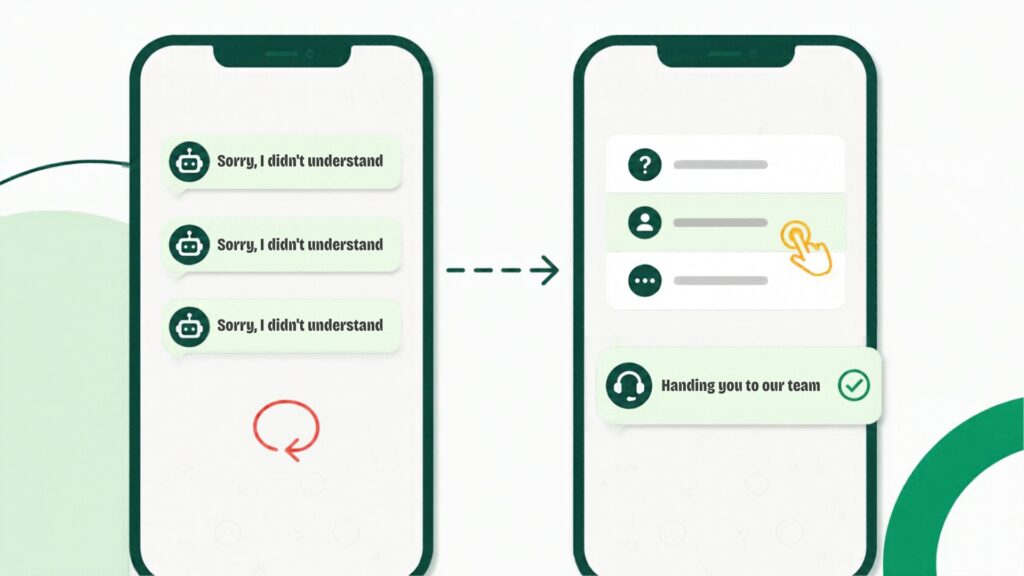
Where static chatbots go wrong
They have no exit. The bot is the only option. If the question is not on the menu, the customer is stuck.
They guess too much. A bot that tries to interpret any sentence will sometimes get it wrong, and a wrong answer is worse than no answer.
They forget what you told them. The customer explains the problem, the bot hands over, and the human asks the customer to start again.
They cannot be inspected. When a customer complains, nobody can see what the bot actually did.
What customers actually want
Customers are usually fine with automation when it saves them time. They get annoyed when it stands between them and a person. A good rule: automation should handle the questions that have a clear, fixed answer, and hand the rest to your team quickly.
Typical questions with a fixed answer include opening hours, price lists, order confirmations, and basic enquiries. Typical questions for a person include complaints, special requests, negotiations and anything emotional.
How to check your own flow
Ask these before you publish:
- Can a customer reach a person within two taps or messages?
- Does the first message say who is speaking and what the customer can do?
- Is every menu option answered, or does something lead to a dead end?
- If someone types something unexpected, does the flow offer a menu again and a way to reach the team?
- Can you read back what the flow did?
That last point matters. In WaSparks, every conversation a flow handles is logged step by step, so you can see where customers go and where they stop.
See it live: Judge a menu-to-team hand-off as a customer would. Tap here to test on WhatsApp (replies in under 5 seconds)
Where Flint fits
Flint is WaSparks’s assistant. Its drafting is free on every plan: it writes templates, quick replies and product copy that you review before use. Flint answering customers is in pilot. When switched on, it answers inside the 24-hour window only from your own business profile, FAQ and catalog, and when it is unsure it says so and hands the chat to your team, tagged and waiting in the inbox. You decide what it may handle and when a person takes over. Details are on the Flint page.
Comparing the approaches
Fixed script bot. Cheap to set up, painful for customers, and hard to maintain.
Visual chat flow. Easy to build and change, transparent through its run log, and designed to hand off to people.
Pure human replies. Best quality, but slow outside working hours and expensive at volume.
Most small teams do best with a flow for the simple questions and people for everything else.
The takeaway
Customers are not against automation. They are against being trapped by it. Keep menus short, answer clear questions directly, and always give a path to a real person. To see how this works in practice, see chat flows or start free.
Found this useful? Share it with your team.