 WaSparks
“That was my customer from Sunday.” Anyone who has managed a sales team has heard it. A lead comes in on WhatsApp, two reps reply, one claims credit, and the customer, who just wanted a straight answer, receives two slightly different ones.
These disputes are rarely about greed. They happen because nobody wrote down who owns a lead and when ownership changes. This guide gives you a short standard operating procedure (SOP) you can adopt this week, and shows how a shared inbox with assignment and transfer makes it enforceable. For the tools involved, see the team inbox features.
Why disputes happen
There is no single owner. When every rep can see and answer every chat, no one is accountable for any of them.
Easy leads get cherry-picked. Reps reply to the chats that look promising and leave the harder ones.
Handovers lose context. A chat passed on without a reason leaves the next rep guessing what was promised.
Customers leave with the rep. If chats live on a personal phone, a rep who quits takes the relationship with them.
There is no record. When a dispute starts, nobody can show who replied first, or when.
The principles behind a fair SOP
- Every chat has exactly one owner at a time.
- Ownership is assigned, not claimed.
- A change of owner needs a stated reason.
- Anyone can see the history, so disputes can be settled with facts.
- Customer contact details stay protected so that leads cannot be taken out of the system.
The SOP, step by step
Step 1: Decide how leads are assigned
Choose one rule and write it down. Common options:
- By product or model. Enquiries about one product line go to the rep who owns it.
- By shift or rota. Whoever is on duty takes new chats.
- By a lead manager. One person assigns each new chat by hand.
- By flow. A chat flow asks a question, such as which product the customer wants, and routes the chat to a chosen team member.
WaSparks supports assigning a chat to a person, transferring it, and routing from a chat flow to a team member you choose. It does not automatically balance load across the team, so decide your rule first and set it up deliberately.
Step 2: Set a first-response standard
Agree a time for the first reply, such as five minutes during working hours. Fast first replies matter because the customer’s window opens when they write, and the first message often decides whether the lead stays.
Step 3: Assign before replying
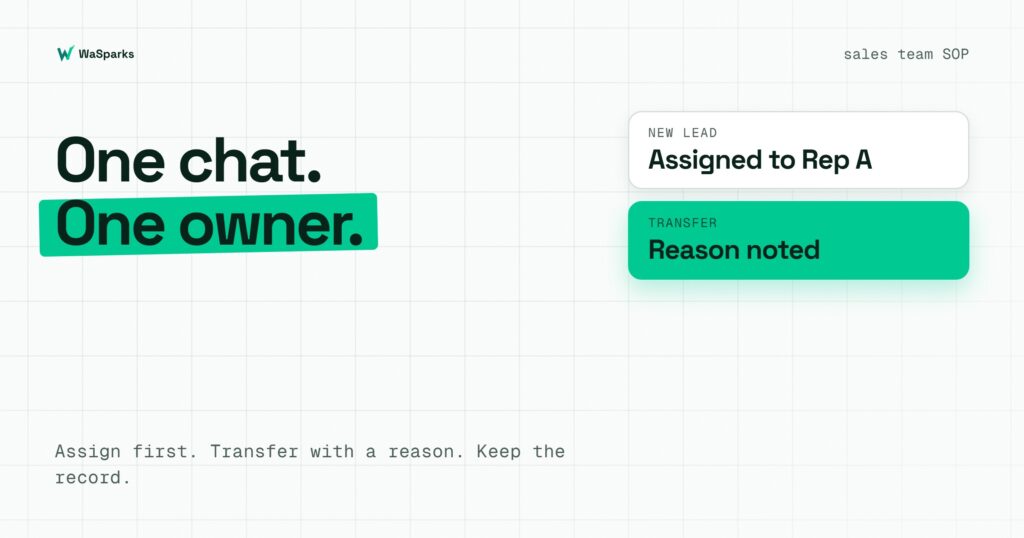
The rule: no one replies to an unassigned chat. The rep takes ownership first, then answers. This stops two people replying at the same moment.
Step 4: Transfer with a reason
When a chat has to move, the current owner transfers it and writes why. Good reasons are specific:
- “Customer wants the SUV, handing to the SUV specialist.”
- “Needs a finance quote, passing to accounts.”
- “I am on leave until Monday.”
A reason turns a handover into a briefing. The next rep knows what was said and why they are involved.
Step 5: Use internal notes for context
Notes are visible to the team and not to the customer. Use them for what was promised, what the customer prefers and what comes next. @mention a colleague when you need their input without transferring the chat.
Step 6: Protect contact details
Phone numbers are masked in campaign reports unless you are an Owner or Admin. Use roles and permissions so each person sees what their job needs. This makes it harder for a rep to copy a customer list and leave.
Step 7: Review with the audit trail
Once a week, the manager looks at the log of changes: who was assigned what, who transferred what and when. If there is a dispute, the record shows who replied first and what was said.
A short dispute-resolution rule
Write this into the SOP so nobody has to argue:
- The rep who was assigned the chat owns it.
- If a chat went unanswered past the response standard, the manager reassigns it, with a reason.
- A customer who returns after 30 days with a new enquiry is treated as a new lead, unless the original rep is still working the account.
Adjust the number of days to match your sales cycle.
What to measure
- First response time. How long a new chat waits for a reply.
- Unassigned chats. There should be none at the end of the day.
- Transfers and their reasons. Many transfers for the same reason suggest your assignment rule needs changing.
- Leads that go quiet, by owner.
Common mistakes
Assigning too late. If the chat sits unassigned for an hour, you have recreated the original problem.
Writing vague reasons. “Other” is not a reason.
Skipping the rule for managers. If managers can grab any chat without a note, reps will do the same.
No consequence for breaking the SOP. A rule nobody follows is worse than no rule, because it makes disputes look official.
The takeaway
Lead disputes end when every chat has one owner, every handover has a reason, and the history is visible to everyone. Write the rule, assign before replying, and review the record weekly. If you want to see it working, start 30 days free, or read how chat flows can route a chat to the right person automatically.
Found this useful? Share it with your team.