 WaSparks
A shop owner asks a simple question: “If I move to the WhatsApp Business API, what will I actually pay each month?” The honest answer has two parts, and most pricing pages only show one. There is a fixed fee for the platform you use, and there is Meta’s own charge for the messages you send. The total is the two added together.
This guide builds that monthly bill with real numbers, for a small shop and for a larger team, so you can see where your own business would land. If you want the rules behind the Meta side first, read how Meta charges per message in 2026.
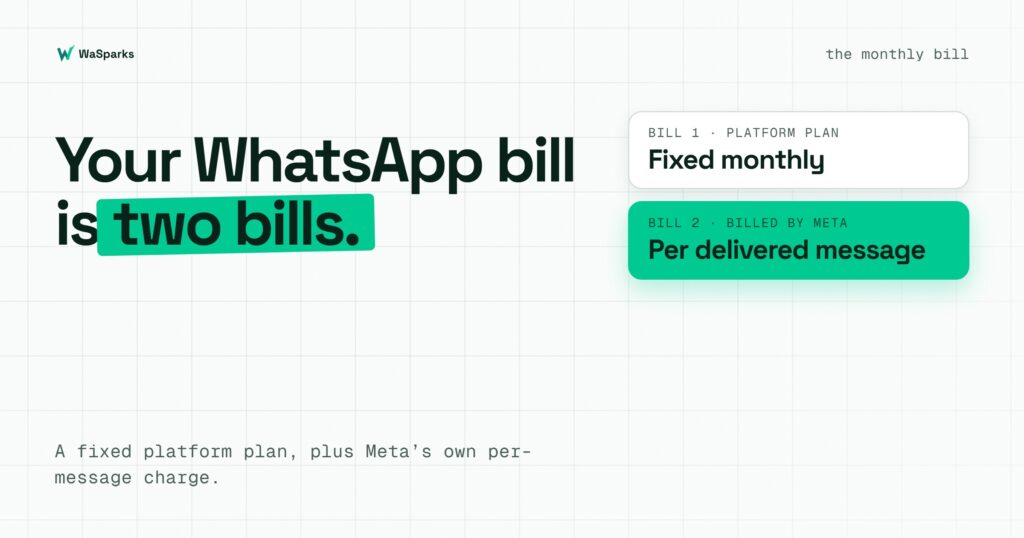
The two parts of your bill
Part 1: the platform plan. This is the fixed monthly fee for the software: the team inbox, campaigns, templates, reminders and API. On WaSparks, the plans are:
| Ember | Spark | Blaze | Inferno | |
|---|---|---|---|---|
| Price (plus GST) | Free for 30 days | ₹1,999 / month | ₹4,999 / month | Custom |
| Messages included | 1,000 | 10,000 | 50,000 | Custom |
| Past the allowance | Stops | ₹0.05 per message | ₹0.03 per message | Custom |
| Team seats | 3 | Unlimited | Unlimited | Unlimited |
| WhatsApp numbers | 1 | 1 | 3 | Custom |
Part 2: Meta’s message charges. Meta charges per delivered template message, by category and country. Meta bills its message charges to your WhatsApp account directly, not through WaSparks. In India, from the rate card effective 1 July 2026, a marketing message is ₹0.8631 and a utility message is ₹0.1150. Replies to customers who message you first are free for 24 hours.
Rates can change at the start of a quarter, so confirm the current figure in the pricing calculator.
Example 1: a small shop on Spark
The shop has 2,500 customers who opted in. In a typical month it:
- Sends one marketing campaign to 2,500 customers, with 2,250 delivered.
- Sends 1,500 order and delivery updates as utility templates outside the window.
- Answers customer replies within a day.
Meta’s charges
- Marketing: 2,250 × ₹0.8631 = ₹1,942
- Utility: 1,500 × ₹0.1150 = ₹173
- Replies: ₹0
- Meta total: about ₹2,115
Platform plan
- Spark: ₹1,999 plus GST
Monthly total: about ₹4,114, plus GST on the plan.
The shop sends 3,750 template messages, well inside Spark’s allowance of 10,000, so there is no overage.
Example 2: a busier store that goes past the allowance
Now the store runs three campaigns a month and sends 12,000 messages in total. It stays on Spark.
- Messages past the allowance: 2,000 × ₹0.05 = ₹100, taken from the prepaid balance.
The extra cost is small, which is the idea. Usage beyond the allowance is paid per message so the inbox never stops. If this happens every month, compare the price of Blaze against the overage.
Example 3: a multi-team business on Blaze
A growing business runs sales and support across three WhatsApp numbers. In a month it:
- Sends 20,000 marketing messages (delivered).
- Sends 15,000 utility messages (delivered).
Meta’s charges
- Marketing: 20,000 × ₹0.8631 = ₹17,262
- Utility: 15,000 × ₹0.1150 = ₹1,725
- Meta total: ₹18,987
Platform plan
- Blaze: ₹4,999 plus GST
Monthly total: about ₹23,986, plus GST on the plan.
The 35,000 template messages sit inside Blaze’s allowance of 50,000. Notice how much of the bill is Meta’s marketing charge, not the platform.
What to notice
Marketing dominates the bill. In the larger example, marketing is more than 70% of the whole total. Controlling how many marketing messages you send, and to whom, has far more effect than choosing between plans.
The platform fee is predictable. It is fixed. Only Meta’s side moves with your volume.
Seats do not change the price. On Spark and Blaze, adding a team member costs nothing extra. On a plan that charges per seat, the bill grows with your headcount.
Free replies matter. Every customer who writes to you first opens a free window. Answer quickly and a good share of your conversations cost nothing at Meta’s end.
What is not in the examples
These figures leave out some things you should add for your own business:
- GST on the plan, and any taxes on Meta’s charges.
- Volume discounts on utility and authentication, which are small at these levels.
- Authentication messages such as one-time passcodes, which cost ₹0.1150 each domestically.
- Messages that fail. They are not billed by Meta.
How to estimate your own month
- Count how many customers you would message with offers, and multiply by your expected delivery rate.
- Count the order, delivery and appointment updates you send.
- Multiply each by the right rate.
- Add the plan that fits your message volume and number count.
- Check the figure with the calculator, and with the estimate WaSparks shows before every campaign sends.
The takeaway
The cost of the WhatsApp Business API is a fixed platform plan plus Meta’s per-message charge, and the second part is usually the larger one. A small shop can land around ₹4,000 a month; a busy multi-team business, around ₹24,000, mostly from marketing messages. Plan the Meta side carefully and keep the platform side simple. You can see the plans, or start 30 days free to try it on your own number.
Found this useful? Share it with your team.